
-- Melbourne-Based, Servicing Victoria & Australia-Wide
Marine Electrical Circuit Identification & Labelling
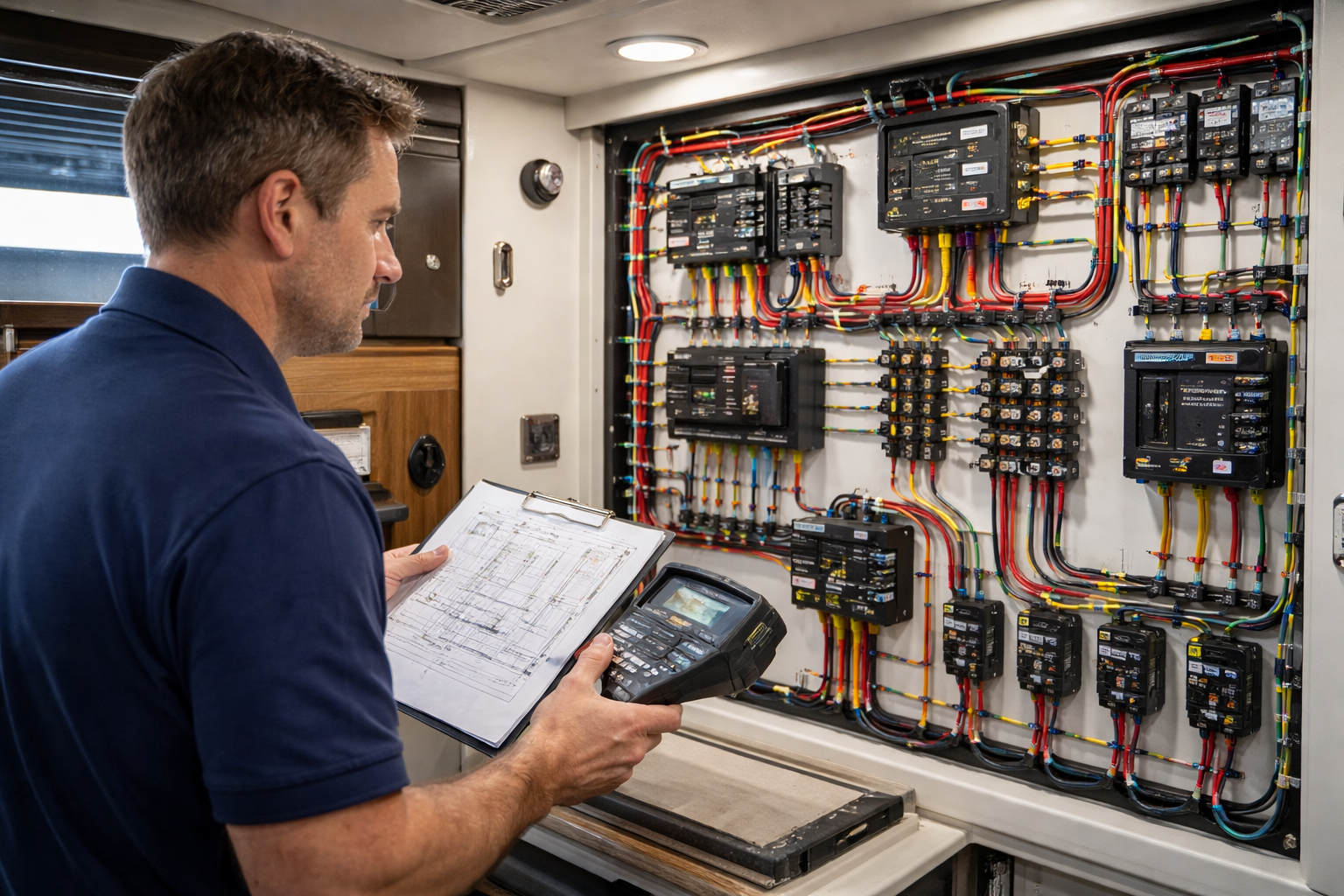
Transform a confusing network of unmarked wires into a clearly identified, professionally labelled installation. Our System Labelling service uses durable, UV‑stable labels on panels, circuits, wires and components to speed up troubleshooting, improve safety, support AMSA/NSCV compliance on commercial vessels, and enhance resale value on leisure boats.
It's the name tag every other system on board already wears — marine grade boat wire labels and panel labels that are still readable years later, tied directly to your electrical schematic.
Essential for Crew
Professional labels help crew members quickly identify circuits and components, improving safety and reducing confusion during operation and maintenance.
Higher Resale Value
Surveyors and buyers value organised, labelled systems; professional labelling reduces survey comments and buyer hesitation.
Safer Maintenance & Modifications
Clear polarity markings, circuit ratings and isolation points reduce the risk of dangerous mistakes during work or upgrades.
Insurance, Survey & AMSA Compliance
Insurers and surveyors expect labelled installations, particularly for high‑value vessels and modified systems — and clear circuit identification and isolation labelling is a standard checkpoint in NSCV surveys for commercial fishing vessels.
Label durability & maintenance
We use high-quality, UV-resistant, marine-grade labels designed to withstand harsh conditions.
Expected lifespans: interior panels 10+ years; engine rooms 5–10 years; exposed locations 3–7 years. Working vessels in daily commercial use will typically sit toward the shorter end of these ranges.
Our Process
Initial Consultation & Quote Request
Our team will assess your electrical needs and provide a detailed quote.
We provide a fixed-price quote covering:
- On-site survey time
- Labels printed and applied to all circuits
- Final documentation and reporting
Survey & Circuit Verification
On‑site testing and planning. Combined surveys available if also commissioning drafting.
We document:
- Existing electrical components and systems
- Circuit details and ratings
- Physical layout and routing
Label Design & Production
We design and produce high-quality labels for all circuits and components in your installation.
We ensure:
- Compliance with AS/NZS 3004 and, for commercial vessels, NSCV labelling requirements
- Labels are waterproof and durable
- Labels are UV resistant
On‑Site Label Application
Our team applies the labels to all circuits and components in your installation.
- Label application is done systematically and accurately
- Surface preparation and cleaning of components
- Quality control checks during application
Final Documentation & Handover
We provide photos, a label schedule, a PDF, and any cross‑referenced electrical schematics.
- Final verification of all labels and documentation
- Photographic record of all labels applied
- Delivery of all documentation and handover to client
"Why Not Just Label It Myself?"
Ordinary label tape doesn't survive where boat wiring actually lives. Cheap tape turns black and unreadable the moment it's heat-shrunk over a termination, and unprotected adhesive labels lift and fall off in a bilge environment within a season.
The real cost isn't the labelling fee — it's every future service call spent re-tracing wires nobody can identify any more, because the one thing every other piece of equipment on board already wears is the one thing the wiring never got.
What Marine-Grade Labelling Locks In
- Labels that survive heat-shrink without blackening or lifting
- Labels that survive a bilge environment for years, not one season
- Every label tied directly to the electrical schematic, not a stand-alone system
- Readable in the dark, in an emergency, by anyone helping you — not just you
- No future service call spent re-tracing wires nobody can identify
Turnaround
Typical turnaround from survey to delivered labelling, by vessel length:
| Vessel length | Turnaround |
|---|---|
| Under 30ft | 5 working days |
| 30–40ft | 6 working days |
| 40–50ft | 7 working days |
| Over 50ft | Confirmed at scoping |
Questions & Answers
Yes, we can label your system even if you don't have existing wiring diagrams. During the initial survey, we will:
- Identify and document all circuits, components and connections
- Use testing equipment to verify circuit functions and ratings
- Create a comprehensive label schedule and photographic record
This allows us to provide accurate labelling and documentation even without prior diagrams.
We will verify all existing labels during the survey. If we find any incorrect or misleading labels, we will:
- Document the discrepancies and their potential risks
- Remove or replace incorrect labels with accurate ones
- Provide recommendations for correcting any underlying issues
Our goal is to ensure your system is accurately labelled and safe to operate, even if that means correcting previous mistakes.
No, we use high-quality, marine-grade labels that are designed to be durable yet removable without damage. Our process includes:
- Careful surface preparation to ensure good adhesion
- Use of adhesives that are strong but can be removed cleanly if needed
- Testing on various surfaces to confirm no damage occurs
In the unlikely event that a label needs to be removed, it can be done without harming your panels or gelcoat.
Yes, we can accommodate custom label text or formats to suit your preferences. During the consultation, you can specify:
- Custom circuit names or descriptions
- Preferred label layouts or sizes
- Additional information such as installation dates or maintenance notes
We will work with you to design labels that meet your specific needs while ensuring they remain clear and compliant with standards.
We label both panels and individual wires as needed. Our standard labelling includes:
- Panel labels with circuit IDs, ratings and functions
- Wire labels for critical circuits, especially those that are not easily traceable
- Component labels for key devices such as batteries, inverters and isolators
The extent of wire labelling can be customized based on your preferences and the complexity of your system.
Our labels are designed to withstand harsh marine environments, including engine rooms and bilges. They are:
- Made from UV-resistant, waterproof materials
- Adhesives formulated to resist heat, moisture and vibration
- Tested for durability in conditions typical of engine rooms and bilges
While no label can last indefinitely in extreme conditions, our products are engineered to provide reliable identification for several years even in challenging locations.
Yes, we can add labels to an existing system even if we didn't originally label it. Our process includes:
- Conducting a thorough survey to understand the current system
- Designing labels that integrate with any existing labelling
- Ensuring consistency in label format and information across the entire system
This allows us to enhance the clarity and organization of your electrical system, regardless of who performed the original labelling.
Marine-grade vinyl/polyester with a saltwater-rated adhesive and thermal-transfer print, versus standard paper or vinyl and general-purpose adhesive from a consumer label maker. See "Why Not Just Label It Myself?" above for what that difference actually means in an engine room or a bilge.
Yes. Clear circuit identification and isolation labelling is a standard checkpoint in NSCV surveys, and it's one of the fastest, most cost-effective things you can do to reduce survey comments on a commercial vessel. For working boats, we typically also label:
- Refrigeration and ice-making circuits
- Deck machinery and hydraulic winch power supply
- VHF/HF radio, EPIRB and navigation/comms circuits
- Multi-engine and genset isolation points
Because working vessels tend to have more circuits than a leisure boat of comparable length, commercial labelling jobs are quoted individually.