
-- Melbourne-Based, Servicing Victoria & Australia-Wide
Standards & Compliance Review
A thorough assessment of your boat's electrical system against AS/NZS 3004 — the applicable Australian standard for electrical installations on boats — with additional reference to ABYC (American Boat & Yacht Council) technical standards, widely used internationally as detailed best-practice guidance for DC and AC systems. We identify risks, non-compliant work and ageing components, and give you a clear, prioritised report to act on.
It's the service record, checked against the standard — the record behind your general survey, not a duplicate of it.
Overcurrent Protection & Earthing
We identify undersized or missing overcurrent protection and earthing issues that can lead to fire risk or electric shock.
Corrosion & Stray Current Risk
Recommendations to reduce galvanic and stray current corrosion risk, protecting your hull fittings, shaft and through-hulls.
Battery & Charging System Checks
Verification of battery banks, charging sources and regulation for safe, reliable operation.
AS/NZS 3004 & ABYC-Referenced
Assessed against the applicable Australian standard, with ABYC E-11 practices referenced for additional technical benchmarking — particularly useful for imported or ABYC-fitted-out vessels.
Our Process
Initial Consultation & Quote Request
Our team will discuss your concerns — a specific issue, an upcoming survey, or a general health check — and provide a detailed quote.
We provide a fixed-price quote covering:
- On-site survey and testing time
- Assessment against AS/NZS 3004 and ABYC practices
- Written report with prioritised recommendations
On-site Survey & Testing
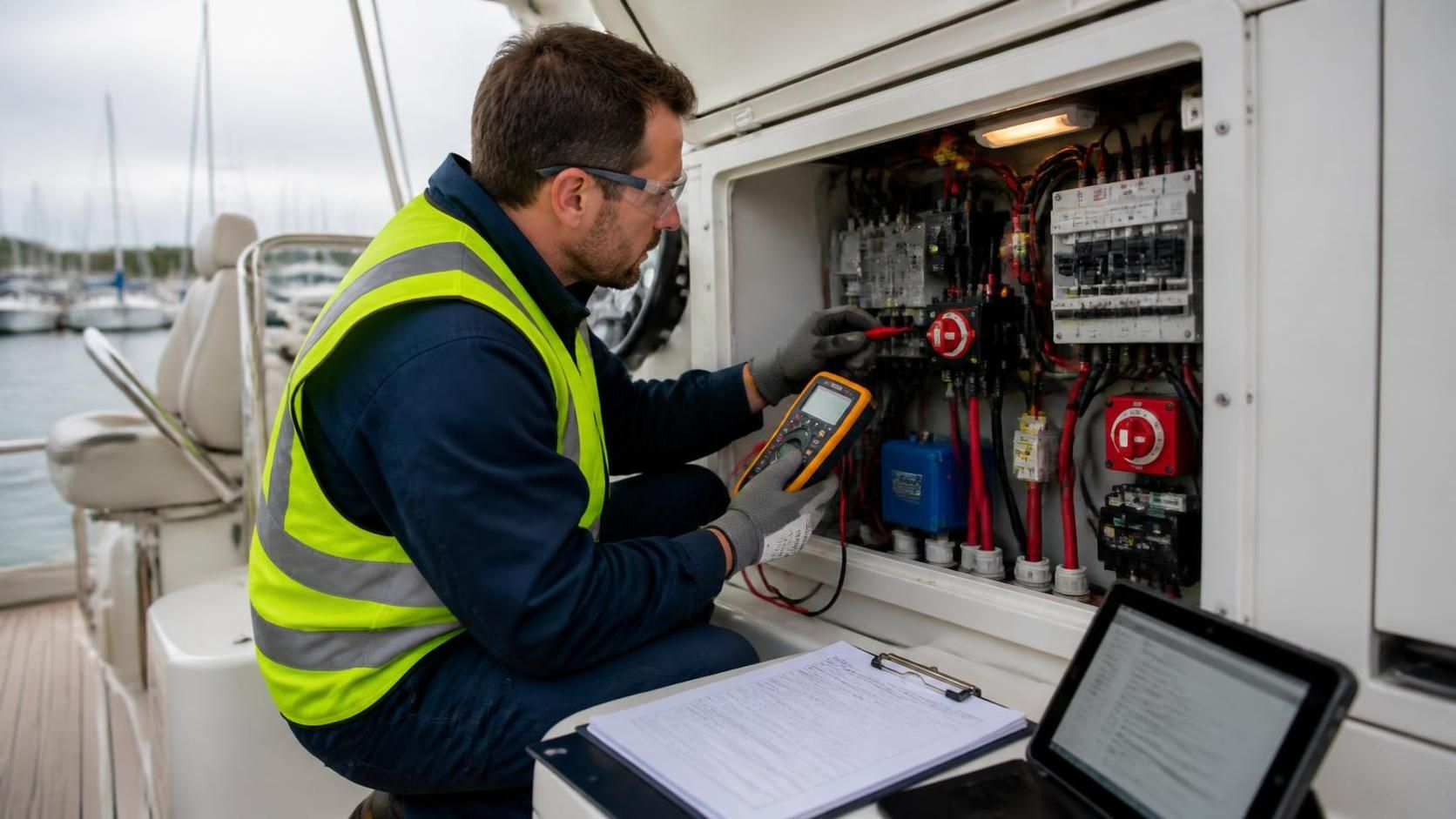
Our team inspects and tests your electrical system on board.
We check:
- Overcurrent protection, wiring gauge and earthing
- Battery, charging and regulation systems
- Corrosion, bonding and stray current risk points
Assessment & Internal Review
Findings are assessed against AS/NZS 3004 and, where relevant, ABYC and NSCV benchmarks, then reviewed for accuracy.
We ensure:
- Every finding is checked against the applicable standard
- Risks are ranked by severity, not just listed
- Recommendations are practical and proportionate to your vessel
Findings Walkthrough
We talk you through what we found, in plain English, before the final report is issued.
- Explanation of each finding and its risk level
- Discussion of remedial options and rough costs
- Opportunity to ask questions before sign-off
Final Report & Recommendations
We issue a signed report with detailed compliance documentation for your records, insurer or surveyor.
- Prioritised list of findings and remedial actions
- Reference to AS/NZS 3004 and, where applicable, ABYC/NSCV
- Delivery as an interactive PDF document
What the Report Contains
Every review is written up as a structured report: each finding assessed against AS/NZS 3004 and, where relevant, the matching ABYC standard, ranked by risk, with a recommended remedial approach and a rough cost against it — written to be acted on directly, not filed away.
What Gets Assessed
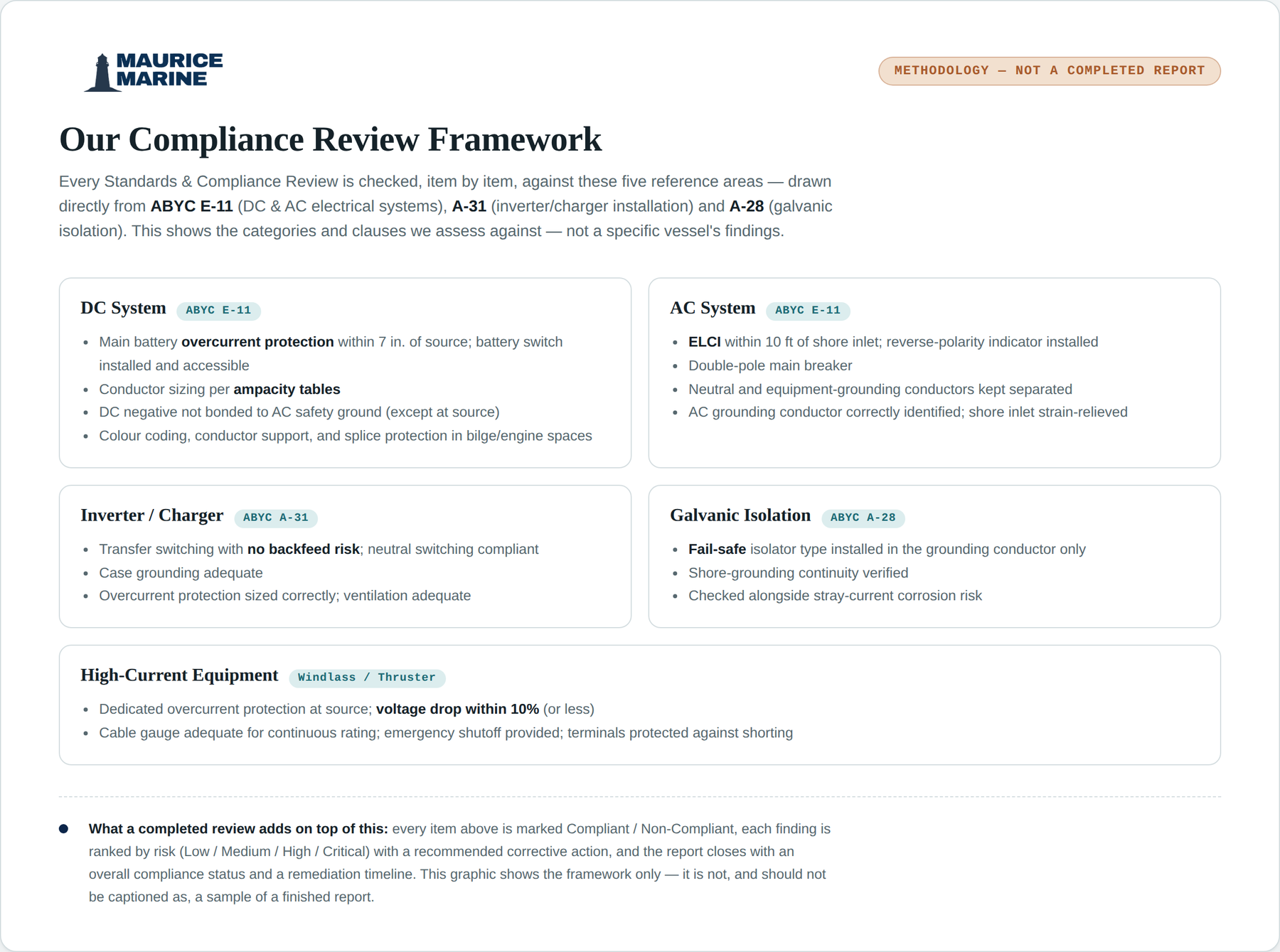
The review works through overcurrent protection, earthing and bonding, galvanic isolation and stray-current corrosion risk, RCD protection, battery and charging systems, and shore-power — checked against AS/NZS 3004 and, for the specific systems below, the matching ABYC standard.
Not a Compliance Certificate
This is an independent standards assessment — the record used for an insurance renewal, a pre-purchase decision, or before a refit begins — not a regulatory certificate.
Commercial Vessels
For commercial fishing vessels, the review takes NSCV (Part C) and AMSA requirements into account and is quoted individually rather than against the standard leisure-vessel tiers.
"After rewiring the boat myself following a seacock accident that flooded it, I brought Maurice Marine in to check the work against ABYC E-11 and E-2. The review caught issues across several areas that would have gone on to cause corrosion — including at the propeller — before they became a real problem."
— Owner, Sparkman & Stephens 32ft
"Isn't This What My Surveyor Already Checked?"
| General condition / insurance survey | Maurice Marine Standards & Compliance Review | |
|---|---|---|
| Scope | Whole boat: hull, engine, plumbing, electrical, sanitation | Electrical only, assessed item by item |
| Time on electrical | Part of a few hours covering the whole boat | The full review, focused entirely on the electrical system |
| Checked against | General condition / insurability | AS/NZS 3004, clause by clause |
| What you get | One line item in a general report | A structured report, ranked by risk, with remedial cost |
| What it's for | Insurability and general condition | The standards-referenced record behind that survey |
Turnaround
Typical turnaround from on-site survey to delivered report, by vessel length:
| Vessel length | Turnaround |
|---|---|
| Under 40ft | 5 working days |
| 40ft and over | 6 working days |
| Commercial fishing | Confirmed at scoping |
Priority scheduling is available for urgent insurance, survey or sale deadlines.
Questions & Answers
ABYC (American Boat & Yacht Council) publishes detailed technical standards for boat electrical systems, most notably ABYC E-11 for AC and DC electrical systems on boats. It is a US standard, not an Australian one — the applicable standard for boats in Australia is AS/NZS 3004, and our reviews are always assessed against that first.
- We reference ABYC as an additional, more granular technical benchmark
- This is particularly useful on US-built vessels or those previously fitted out to ABYC practice
- Any ABYC-referenced finding is clearly distinguished from an AS/NZS 3004 compliance finding in your report
This gives you a more complete picture of your system's condition than a bare compliance check alone.
If we find an issue that poses an immediate safety risk (such as exposed live conductors or a missing earth), we will:
- Flag it to you immediately, not just in the final report
- Explain the risk in plain language
- Recommend whether the vessel should be used before it's addressed
Lower-priority findings are documented with recommended timeframes for remediation rather than treated as urgent.
The review identifies and documents issues against AS/NZS 3004 and prioritises them by risk. The report is written to be acted on directly:
- Enough detail to scope the remedial work
- Recommended approaches and rough costs where useful
- Electrical Schematic Updates or Upgrade Planning can follow on if you're planning broader work
Our reports are prepared with insurer and surveyor expectations in mind, referencing AS/NZS 3004 and, where relevant, ABYC and NSCV benchmarks.
- Signed report with detailed compliance documentation
- Clear findings, risk ranking and recommended actions
- Structured for easy review by a third party
If your insurer or surveyor has a specific reporting format they require, let us know during consultation and we'll do our best to accommodate it.
Typical turnaround is 5 working days from the on-site survey for vessels under 40ft, rising to 6 working days for 40ft and over. Commercial fishing vessels are confirmed at scoping.
- Consultation & quotation
- On-site survey and testing
- Assessment and internal review
- Findings walkthrough with you
- Final issue of the report
Priority scheduling is available for urgent insurance, survey or sale deadlines.
Yes. Alongside leisure boats, we review commercial fishing vessels with an eye to NSCV survey requirements, including:
- Overcurrent protection and earthing across multi-engine or genset systems
- Refrigeration, deck machinery and comms circuit safety
- Battery and charging system reliability for working conditions
Because working vessels are typically more electrically complex than a leisure boat of the same length, commercial reviews are quoted individually after an initial consultation.